
 Author:
Eric Bernstein
Author:
Eric Bernstein
Published:
As a real estate investor, you already understand the power of rental income and how it can steadily grow your wealth. But with the expansion of your property portfolio, securing financing becomes more complex and restrictive.
That’s why a few options, such as debt service coverage ratio (DSCR) loans and conventional loans, you may want to consider to understand which one suits you the best
Both financing paths can help you acquire properties, but they work in very different ways. One focuses on your personal income, while the other focuses on the property’s cash flow.
In this guide, we’ll break down both options so you can decide which loan truly fits your investment strategy.
What Is a DSCR Loan?
A DSCR (Debt Service Coverage Ratio) loan is a type of non-qualified mortgage (non-QM) designed mainly for real estate investors.
Instead of checking your salary or tax returns, lenders evaluate whether the property itself generates enough rental income to cover the mortgage payments.
This makes DSCR loans especially useful for investors scaling portfolios in high-value markets such as Florida vacation rentals, Texas long-term rentals, and California appreciation-driven properties.
How DSCR Loans Work
Lenders calculate the DSCR ratio using:
DSCR = Net Operating Income (NOI) ÷ Annual Mortgage Payments
- A DSCR of 1.0 means the property breaks even.
- A DSCR of 1.25 means it generates 25% more income than its annual debt obligations.
For example, if a property generates $120,000 in annual net operating income and your mortgage payments are $96,000, your DSCR is 1.25, which is considered strong in most investor markets.
However, DSCR loans are more flexible than many investors realize. Some lenders can approve loans with a DSCR as low as 0.75, but this comes with trade-offs and higher interest rates.
Key Features of DSCR Loans
- No W-2 or tax return requirement (in most cases)
- Qualification based on rental income
- Designed for investment properties only
- Flexible for real estate investors
- Usually requires 20%–30% down payment
Who Uses DSCR Loans?
- Real estate investors
- Self-employed borrowers
- Buyers scaling rental portfolios quickly
- Investors using LLCs for property ownership
What Is a Conventional Loan?
A conventional loan is a traditional mortgage offered by private lenders such as banks and credit unions. It follows guidelines set by Fannie Mae and Freddie Mac.
Unlike DSCR loans, conventional loans focus heavily on the borrower’s personal financial profile.
They are commonly used for both primary residences and investment properties, but are more restrictive for investors scaling multiple homes.
Key Features of Conventional Loans
- Requires income verification (W-2s, tax returns)
- Based on credit score and debt-to-income ratio
- Can be used for primary homes and investment properties
- Typically, lower interest rates compared to DSCR loans
- Investment property down payments typically range from 15%–25%.
Who Uses Conventional Loans?
- First-time homebuyers
- Borrowers with stable income and strong credit
- Investors purchasing a limited number of properties
Key Differences: DSCR Loans Vs Conventional Loans
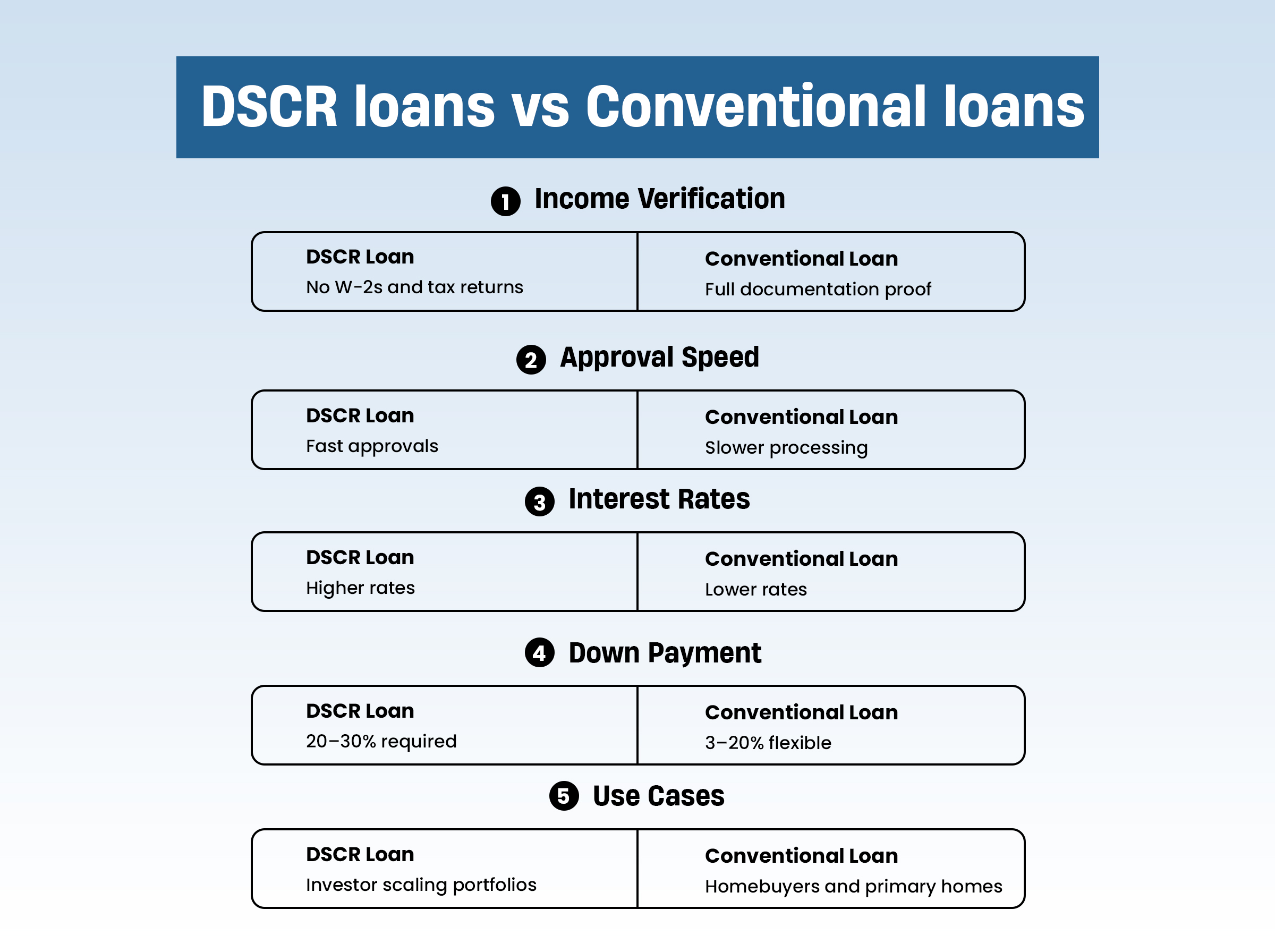
Here is a simple breakdown of the differences between DSCR and conventional loans for real estate investors.
|
Feature |
DSCR Loans |
Conventional Loans |
|
Income Verification Requirements |
No personal income verification required Approval based on property rental income |
Full income verification required (W-2s, tax returns, pay stubs) |
|
Credit Score Requirements |
720, depending on lender and property cash flow strength |
620+ minimum, with best scores (720) preferred for better rates |
|
Qualification Criteria |
Based on the Debt Service Coverage Ratio (property cash flow) |
Based on credit score, income stability, and debt-to-income (DTI) ratio |
|
Property Type Rules |
Mainly for investment properties (must generate rental income) |
Primary homes, second homes, and investment properties allowed |
|
Interest Rates and Down Payments |
Higher interest rates 20%–30% down payment |
Lower interest rates Down payments range from 3%–20% for investment properties |
|
Ownership Structure |
Often allows LLCs |
Typically, in a personal name |
Pros and Cons of DSCR Loans vs. Conventional Loans
Before choosing between the two financing options, it’s important to understand the full breakdown of the pros and cons of DSCR and conventional loans, especially for investors working with $1M+ properties in competitive markets.
Pros of DSCR Loans
- No personal income verification required (no W-2s, tax returns, or pay stubs)
- Approval based on the property’s rental income (cash-flow driven lending)
- Ideal for real estate investors scaling portfolios in $1M+ markets
- Can be used under LLC ownership for liability protection
- Faster approval process compared to conventional loans
- Works well in high-rent states, such as Florida, Texas, and California
- Flexible option for self-employed or high-tax-structure investors
Cons of DSCR Loans
- Higher interest rates compared to conventional mortgages
- Larger down payment requirement (typically 20%–30%)
- Only available for investment properties (not primary residences)
- Property must generate sufficient rental income to qualify
- Limited lender options compared to conventional financing
- Can become expensive over long-term holding periods
Pros of Conventional Loans
- Lower interest rates and overall borrowing costs
- Flexible down payment options (as low as 3%–20%)
- Can be used for primary homes, second homes, and investments
- Strong long-term stability due to Fannie Mae/Freddie Mac standards
- Widely available from banks, credit unions, and mortgage lenders
- Predictable underwriting guidelines
Cons of Conventional Loans
- Requires full income verification (W-2s, tax returns, employment proof)
- Strict debt-to-income (DTI) ratio limits
- Slower approval due to heavy documentation requirements
- Difficult to scale for investors with multiple properties
- Not ideal for self-employed investors with complex tax structures
- Qualification is tied heavily to personal income, not property performance
When to Choose: DSCR Loan vs Conventional Loans
When to Choose a DSCR Loan
Choose a DSCR loan if:
- The property generates high, stable rental income
- You are actively scaling an investment portfolio in markets like Florida, Texas, or California
- You want faster, documentation-light approvals
- You prefer a qualification based on property performance instead of personal income
- You plan to hold properties under an LLC or investment structure
- You are investing in $1M+ real estate with strong cash-flow potential
- You prioritize flexibility and speed over the lowest borrowing cost
Avoid a DSCR loan if:
- You are highly sensitive to interest rates and long-term monthly payment increases
- The property has weak, seasonal, or uncertain rental demand
- You are purchasing a primary residence
- You want the lowest possible financing cost available in the market
- You prefer strict, traditional lending protections and regulations
When to Choose a Conventional Loan
Choose a conventional loan if:
- You have a stable W-2 income and can easily verify earnings
- You are buying a primary residence or second home
- You qualify easily based on your credit score and debt-to-income ratio
- You want the lowest available interest rates and long-term cost efficiency
- You are purchasing fewer properties with a long-term holding strategy
- You prefer traditional, highly regulated mortgage structures
Avoid a conventional loan if:
- Your income is difficult to document (self-employed, investor-heavy income, or tax-optimized structure)
- You are scaling multiple investment properties quickly
- You need fast approvals in competitive $1M+ real estate markets
- You want flexibility for LLC-based investment ownership and portfolio expansion
How Investors in Different States Use These Loans Differently
While DSCR and conventional loans are used nationwide, investors in high-value real estate markets such as Florida, Texas, and California rely on these financing options more frequently due to stronger rental demand, higher property prices, and active investment activity.
Florida
Investors often prefer DSCR loans in Florida for short-term rental (Airbnb and vacation properties). However, markets like Miami, Orlando, and Tampa benefit from strong tourism demand, that allow rental income to drive loan qualification.
Texas
DSCR loans in Texas are widely used for portfolio expansion strategies in cities such as Dallas, Houston, and Austin. The state’s landlord-friendly regulations and consistent population growth make it ideal for scaling investment properties.
California
In California, investors often use conventional loans for long-term appreciation-focused properties in markets like Los Angeles and San Diego. However, DSCR loans in California are also used for $1M+ rental properties, especially when borrowers have complex or non-traditional income structures.
How the Right Lender Helps Investors Decide Between DSCR and Conventional
Choosing between a DSCR loan and a conventional loan can be challenging, especially when dealing with $1M+ investment properties. The right lender helps simplify this decision by assessing your financial profile, investment goals, and property performance.
A strong investor-focused lender, such as LendFriend Mortgage, helps guide you based on how you plan to structure and scale your investments.
How the Right Lender Guides Your Decision:
- Evaluates your income structure
Determines whether your income profile fits better with conventional underwriting or DSCR-based qualification. - Aligns with your investment goals
Helps decide whether your priority is lower interest rates (conventional) or faster, cash-flow-based approvals (DSCR). - Assesses property performance potential
Reviews rental income strength and market conditions to determine DSCR eligibility. - Supports strategy for high-value properties
Especially important when financing $1M+ rental properties in markets like Dallas, Florida, and California. - Helps optimize loan structure
Guides investors toward the most efficient financing option based on long-term portfolio growth plans.
Whether you are acquiring a high-value rental property in Dallas or expanding into fast-growing markets across Florida and California, the right lender ensures your financing strategy aligns with your investment objectives.
FAQs
Is a DSCR loan a conventional loan?
No, a DSCR loan is not a conventional loan. Conventional loans follow guidelines set by Fannie Mae and Freddie Mac and require personal income verification. DSCR loans are non-qualified mortgages (non-QM) and are based on the property’s rental income instead of the borrower’s income.
Are DSCR loans more expensive than conventional loans?
Yes, DSCR loans typically have higher interest rates and larger down payment requirements compared to conventional loans. This is because they carry a higher risk for lenders and are designed for investment flexibility.
Can I use both DSCR and conventional loans in my portfolio?
Yes, many investors use both strategies. Conventional loans are used for primary residences or early investments, while DSCR loans are used for scaling rental portfolios and acquiring multiple properties.
What credit score is required for DSCR vs conventional loans?
Both DSCR and conventional loans typically require a credit score of 720+ for competitive approval and better interest rates.
Final Thoughts
DSCR and conventional loans remain two of the most important financing options for real estate investors for those purchasing $1M+ properties in markets like Florida, Texas, and California.
DSCR loans are best suited for investors who want to scale quickly using rental income and flexible qualification, while conventional loans continue to be the preferred choice for borrowers with strong, verifiable income seeking lower long-term costs.
The right financing decision depends on your investment strategy, income structure, and portfolio goals.
At LendFriend Mortgage, we help real estate investors compare DSCR and conventional options side by side and connect them with the right lending solutions for their investment needs.
Schedule a call today or get in touch by completing this quick form, and we'll help you start building your real estate empire.